Eight building blocks. One foundation for performance.
Most companies already have all eight building blocks in some form. CompanyOS makes them explicit, measurable, and mature — giving leadership a clear picture of where the organization stands and what to move next.
Setup Is Not Enough.
A building block is operating and manageable only when two layers are complete.
The structure, method, and foundation exist. Documented, tooled, versioned, and the people who need to use it are trained.
The system is actually applied. It has run, produced outputs, and the rhythm is established.
Defining setup without proof is theatre. Running without setup is chaos. CompanyOS holds both to account.
Eight Interconnected Building Blocks
CompanyOS encompasses all capabilities required for continuous transformation, structured into eight interconnected building blocks. Each block both constrains and enables the others, maturing collectively as the organization develops.
Direction & Purpose
Why the company exists, where it's going, and the principles that guide decision-making.
Roles & Culture
Who's accountable for what, and the behaviors the company actually rewards.
Processes & Infrastructure
The workflows that deliver customer value and the systems that ensure their efficiency.
Methods & Tools
How the work gets done reliably, and the tools that support each method.
Data & KPIs
Reliable metrics that show whether the company is performing, and the data they rest on.
Goals & Cadence
Clear, measurable goals, reviewed on a regular rhythm that sustains momentum.
Leadership & Communication
How decisions get made and travel through the organization, openly enough to keep people aligned.
AI & Automation
Where AI and automation do real work — lifting productivity and building people's skills.
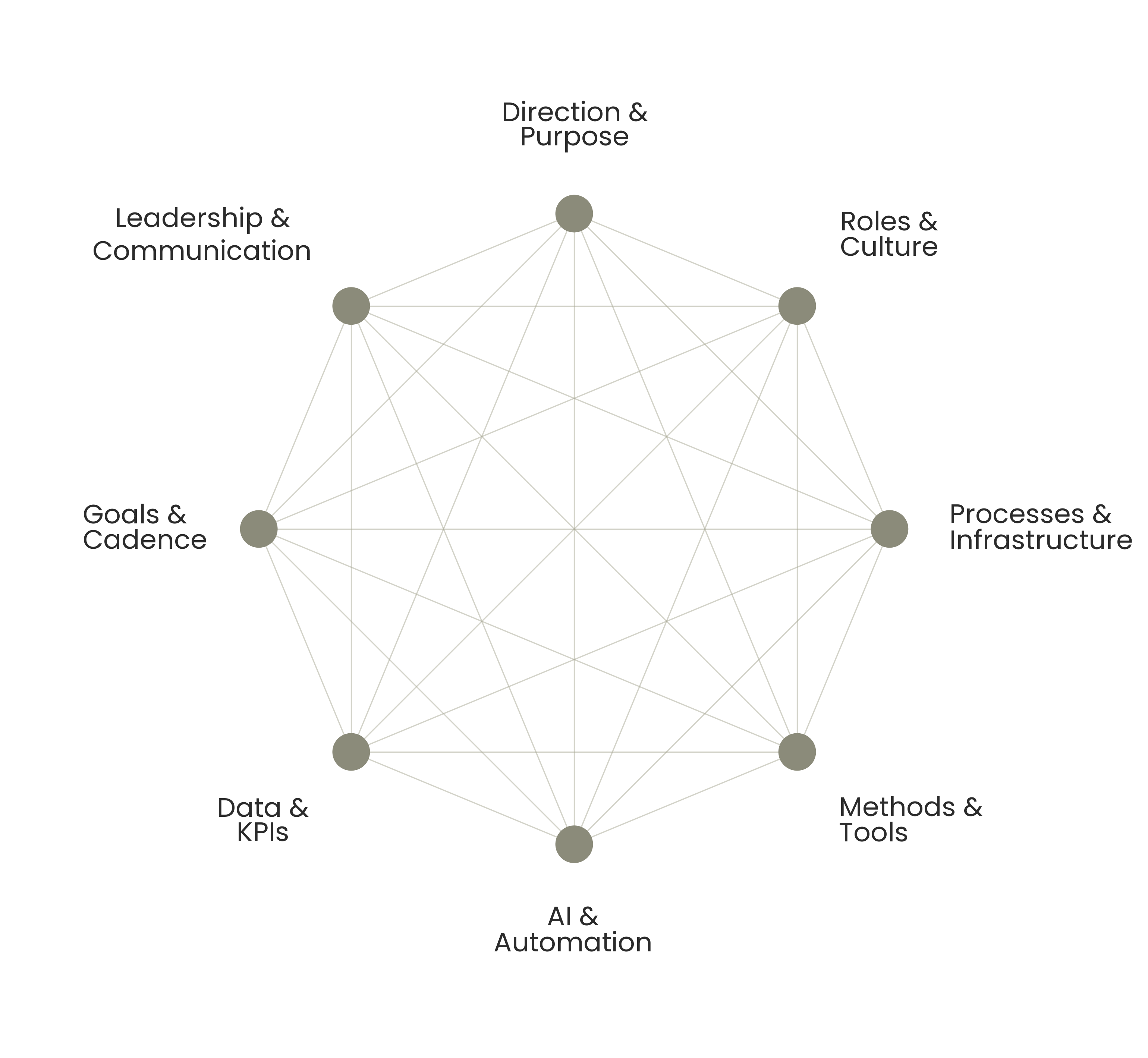
A living state model, not a static system. At any point, it shows which block is in which state and how it's performing — the same readable surface a leadership team uses to align is the one that briefs an agent. You can see where you stand and what to move next.
The eight building blocks are the foundation. Most companies already have some version of each — but not structured enough to perform at full capacity, adapt to change, or reliably host AI capabilities. CompanyOS makes them explicit, measurable, and mature enough to do real work.
What Each Block Looks Like When It's Working
Each block below expands to show its sub-components, what needs to be in place, and what proves it's running.
- A purpose statement is defined and published — mission, vision, or both — in one sentence people can remember
- The purpose statement is accessible to the whole organization in a single, canonical document
- Team members can articulate the purpose without prompting
- New hires encounter the purpose statement in onboarding and can reference the canonical document
- At least one decision in the past 90 days was framed or rejected using the purpose statement
- A North Star Goal is defined and published: 3–10 year horizon, metric expressed as a rate that captures the business model
- A strategic decision framework exists — defining how decisions are made, documented, and reviewed
- Both the North Star and the decision framework have been communicated across the organization
- Strategic decisions from the past 90 days can be traced back to the North Star
- Decisions are documented in the defined format and accessible
- At least one documented instance of the North Star being used to reject or modify a decision
Accelerated by the Purpose Statement Reality Check Agent and 4 templates and skills. See the Agent Harness layer →
- For each role: a job description, performance review template, and development plan exist
- A responsibility mapping (RACI or equivalent) exists for cross-functional processes — defined, documented, and versioned
- Accountability structures are defined: who reviews what, at what cadence, and with what consequences
- Handoffs and escalations happen as designed without constant management intervention
- People can name their own and their colleagues' primary responsibilities without ambiguity
- At least one example of accountability being enforced using the defined structure
- Cultural values are documented with concrete, observable behavioral examples — not just words on a wall
- A hiring evaluation framework maps each value to interview criteria and observable behaviors
- Performance review templates include a culture dimension with behavioral indicators per value
- Onboarding explicitly covers culture: new hires encounter the values with behavioral examples in their first week
- Culture values appear in hiring decisions — at least one hire in the past 90 days was evaluated against the behavioral framework
- Performance conversations include culture observations with specific behavioral examples
- At least one leadership decision or action in the past 90 days was explicitly framed using a cultural value
- Team members can describe the culture using behavioral examples, not just value names
Accelerated by the RACI Review Agent, Role Overlap Detector, and 5 templates, skills, and apps. See the Agent Harness layer →
- A process design and documentation approach is itself documented — the method for how processes are defined, managed, and maintained
- All core processes are documented, versioned, and implemented using the defined approach
- Process ownership is assigned: one person per process is accountable for its health
- Processes are followed consistently — deviations are caught and addressed, not silently tolerated
- Dashboards exist measuring the performance of core processes
- At least one process has been reviewed, updated, or optimized since initial setup
- An infrastructure map exists documenting each infrastructure component
- All components are managed in an Asset & Configuration Management system (CMDB)
- The infrastructure map is versioned and maintained
- The infrastructure map is current and reflects actual deployed components
- Configuration changes are logged and traceable in the CMDB
- At least one infrastructure component has been reviewed or updated using the CMDB as the source of truth
Accelerated by the Process Deviation Agent, Customer Journey Agent, and 10 templates, apps, and workflows. See the Agent Harness layer →
- Core methods are defined, documented, trained, and versioned
- Method fluency is embedded in role descriptions, performance reviews, and development paths
- Team uses defined methods consistently — outputs follow the expected format and quality
- New team members can onboard using documented methods without relying on tribal knowledge
- At least one round of method improvement has happened based on team feedback or observed friction
- Core tools are tailored to methods, trained, and managed
- A tool map exists: visual, showing interconnected tools with documentation of main use cases and data management per tool
- Tool adoption is measurable and active across the team
- The tool map is current and reflects actual tool usage
- At least one tool has been reviewed or replaced based on method fit
Accelerated by the Tool Optimization Agent and 7 templates and skills. See the Agent Harness layer →
- Core KPIs are defined, documented, and versioned: metric name, definition, owner, target, reporting frequency
- Dashboards exist on two levels: company-level and area-level
- Dashboards are reviewed on the defined cadence — not just available, but used in decisions
- Decisions in the past 90 days can be traced back to KPI data
- At least one anomaly has been caught by the system and actioned
- A standard 6-stage data framework is defined, documented, and versioned
- Data ownership is assigned: one person per data domain is accountable for accuracy
- Data sources are identified, connected, and trusted — one source of truth per metric
- Data quality issues are surfaced, logged, and resolved — not quietly tolerated
- The 6-stage framework is applied consistently across data domains
- At least one data quality review has been completed
Accelerated by the KPI Anomaly Detector, KPI Metric Agent, and 6 templates and workflows. See the Agent Harness layer →
- A goal-setting and management method is defined, documented, and trained
- Tooling is configured for goal documentation, updates, and reviews
- Goals are documented and pass eval criteria: each has an owner, a metric, and a timeline
- Goal owners perform regular updates — quantitative and qualitative — on the defined cadence
- At least one goal cycle has been completed: achievement rate, learnings, and adjustments are on record
- Core meeting types are defined, documented, and managed: board, leadership, all-hands, and others relevant to the organization
- For each meeting type: preparation, facilitation, and follow-up processes are documented
- The full annual cadence is planned and scheduled
- Core meetings are running regularly with documented preparation, facilitation notes, and follow-ups
- Leadership reviews are happening at defined intervals and sessions are documented
- At least one full quarter of cadence has been executed and documented
Accelerated by the GPDT App, Goal Review Agent, and 12 templates and skills. See the Agent Harness layer →
- Leadership principles are defined with concrete, behavioral examples — what good leadership looks like in this company
- Feedback mechanisms are established: upward, peer, and downward channels with clear processes
- Feedback loops are active — at least one round has been collected, processed, and acted on with a visible output
- Alignment can be assessed — at least one data point exists (survey, NPS, 1:1 theme tracking)
- Communication formats and templates are in place for key messages: all-hands, team updates, decisions, difficult news
- Meeting structures are defined for all recurring formats: purpose, format, cadence, owner
- Regular communication cadences are running and documented — all-hands happened, notes are accessible
- Leadership decisions are communicated using the defined format; team can access the rationale
Accelerated by the Communication Cadence Tracker and 5 templates and workflows. See the Agent Harness layer →
- AI use cases are identified and prioritized per function
- AI capabilities are deployed and integrated to match identified use cases — covering tools, agents, agent harnesses, and AI-powered workflows
- Team is trained on deployed capabilities; an upskilling roadmap exists for expanding adoption
- AI capabilities are in active daily use — measurable across tools, agents, and workflows
- Team members are regularly identifying new use cases — the capability is self-reinforcing
- Automation use cases are identified and prioritized per function
- Automated workflows are documented: what runs automatically, what requires human input, and where handoffs happen
- At least one manual process has been replaced or significantly accelerated by automation
- Productivity gains are documented: time saved, errors reduced, or output increased
Accelerated by the AI Use Case Discovery skill, Automation ROI Tracker, and 6 templates and skills. See the Agent Harness layer →
The building blocks define the destination. The Agent Harness is what gets you there — a fleet of templates, skills, agents, apps, and workflows that accelerate Setup and automate Proof across all eight blocks. See the Agent Harness layer →
Ready to see where your eight blocks stand today?
The CompanyOS diagnostic maps your current state across all eight blocks, identifies which one to move first, and scopes what it takes to get there.